

Design
"Design is not just what it looks like and feels like. Design is how it works."
— Steve Jobs
In the context of DESIGNHANSA, Dr. Richard Y.F. Tsai’s work is characterized by the integration of physical architecture with digital interaction. While many of his consulting projects for high-tech firms remain under non-disclosure agreements, his "notable designs" are best understood through the specific frameworks and award-winning methodologies he employs.
Product
.jpg)
In the realm of product design, we offer a distinct consulting advantage by treating every product as a fusion of architecture, engineering, and emotion. The agency leverages two proprietary frameworks— Design Object and Relational Experience Management—to transform traditional hardware into intelligent, market-leading solutions.
Notable Designs & Brand Collaborations
Rebhan

Dr. Tsai has a long-standing partnership with this German manufacturer which started back in his days as a student. His detailed approach to every design and elegance resulting in long-term production and licensed applications across multiple products.
KLUDI

The form borrows the abstract geometry of stone grinding tools, translating the essence of water through an object-based logic.
By introducing glass, the design marks its first use in faucet design.
Gaming PC Chassis System for Thermaltake

Design of a high-performance gaming PC chassis system integrating form, airflow, and thermal management.
The project is grounded in an essential tracing of design principles and reinterprets them within consumer electronics, focusing on reduced visual mass, legible structural logic, and efficient heat dissipation.
Modular Roof Carrier System for Mercedes-Benz

Design supervision of a modular roof carrier system developed for long-lifecycle automotive platforms.
The project focuses on structural clarity, modular adaptability, and durability, while ensuring formal coherence with the Mercedes-Benz product family, translating platform constraints into a robust and scalable product architecture suitable for diverse vehicle variants and usage scenarios.
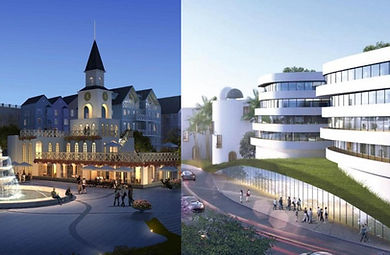
Architectural works presented here are not positioned as standalone building design, but as explorations of spatial and structural thinking across scales, informing product and system-oriented design approaches.
Architecture
.jpg)
Built Work
.jpg)
Self-initiated architectural project combining planning, design and realization.
The building serves as a real-scale testing ground for spatial proportion, structural logic and long-term use, translating design thinking into built reality.
Concept → Form
.jpg)
Exhibition architecture derived from the abstraction of salt crystallization, responding to the cultural and industrial identity of Haiyan.
The project explores how natural formation principles can inform spatial organization and structural expression at an urban scale.
System Thinking

Large-scale leisure masterplan integrating architecture, landscape and circulation systems.
The project focuses on organizing spatial sequences and programmatic relationships across a 22-hectare site, balancing natural topography with human activity.
Smart City/Transportation

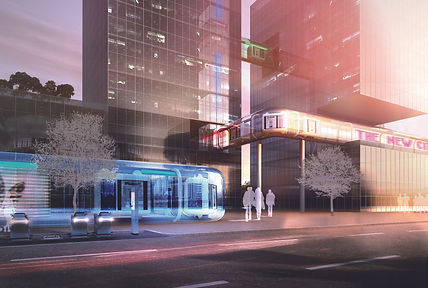
DESIGNHANSA’s consulting for smart city public transportation systems is built on the belief that technology should serve the human experience, not overwhelm it. This section presents transportation and mobility projects approached as interconnected systems rather than isolated vehicles. The works explore relationships between product, infrastructure and user movement across different scales.
Based on proprietary patents, the project brings together private mobility vehicles and a three-dimensional PRT system to form an early prototype of a smart urban mobility ecosystem integrated into a city cloud framework.
This system-oriented approach has been recognized with the Red Dot Design Award and the German Design Award.
From Mobility Object to Urban System

A system-driven approach to future transportation design,
based on problem discovery and iterative PDCA cycles,
reframing traffic congestion as a design and system inefficiency.
Dual-Track Electric Motorcycle with Ground-Integrated Lift
.jpg)
Electric motorcycle design featuring a dual parallel mono-wheel configuration, enhancing stability and delivering a horse-riding-like comfort experience.
The ground-integrated lift improves safety and ease of access in dense urban riding scenarios.
Two-Person Electric Micro-Vehicle System
.jpg)
Compact electric vehicle system designed for passenger and cargo transport.
Ground-integrated lifting enables safe and convenient boarding, supporting both shared autonomous use and private driving in urban environments.
The front and rear wheels support differential steering up to 90 degrees,
allowing the vehicle to move laterally and dock directly at the curb.
The ability to lower the vehicle during entry and exit enhances passenger safety and stability. Inductive charging can be embedded within conventional parking surfaces
without requiring extra spatial allocation.
Modular PRT System for Three-Dimensional Urban Mobility
.jpg)
Conceptual design of a modular Personal Rapid Transit (PRT) system for approximately 10-15 passengers per unit.
The system allows 90-degree turns, enabling close integration with buildings and movement across multiple architectural levels.
The project explores optimization potentials of the existing Düsseldorf Airport SkyTrain system through iterative design development, while also examining architectural integration scenarios with the thyssenkrupp MULTI system that link vehicle design with building-based mobility infrastructure.